
The vision that never left
How a single image set everything in motion


Years ago, I saw a catalog cover that imprinted itself on my brain.
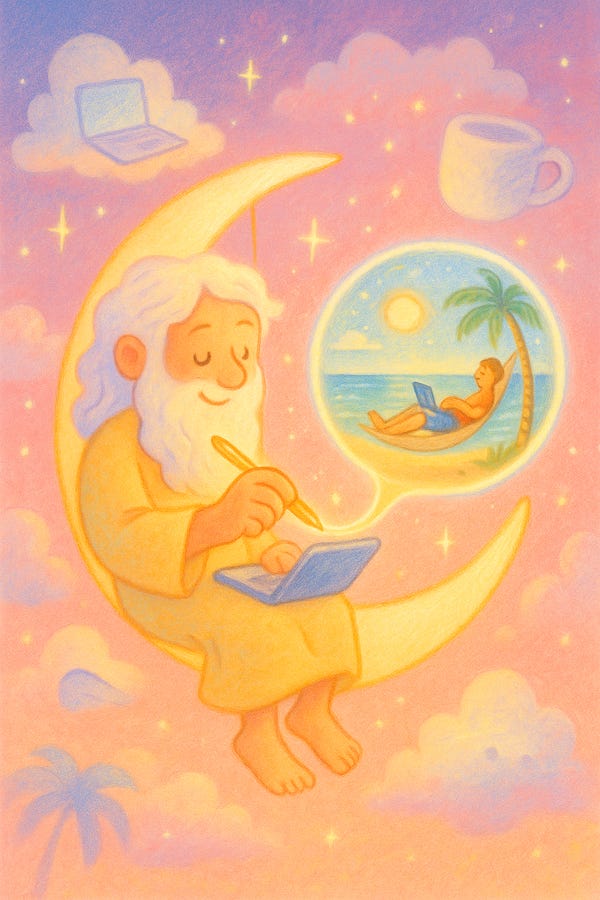
It showed a writer lounging in a hammock, laptop perched on knees, a turquoise ocean in the background. The Barefoot Writer from AWAI.
The headline promised freedom: “Get paid to write from anywhere.”
At the time, I was working restaurant shifts, juggling odd jobs, and trying to figure out how to make ends meet.
I remember thinking, I want that life.
It wasn’t the tropical fantasy that grabbed me so much as the feeling it represented: ease, autonomy, the sense that mere words could open doors. I liked writing and it had always come easily to me, so the dream actually seemed within reach.
I didn’t visualize it daily. I didn’t make a vision board. I just saw it once, felt it in my bones, and moved on.
A decade or so later, I found myself in a casita in Mexico, hammock overlooking the ocean, laptop on my knees, working on a copywriting assignment.
I had become the barefoot writer.
But the path there? It was anything but a straight line.
Let’s rewind.
Ambivalent beginnings
When I was 12, I went to a summer camp for creative writing. Our teacher told us there are lots of ways to make a living as a writer — not just fiction and poetry.
He held up the glossy brochure advertising the camp that our parents had received in the mail. “Somebody had to write that,” he said.
I thought, God, that sounds depressing.
Fast-forward to college. I was a liberal arts major, and my parents were terrified I’d become the starving-artist stereotype. My mom gave me The Copywriter’s Handbook by the great Bob Bly.
At the time, I had zero interest. It sounded about as thrilling as balancing spreadsheets.
But as graduation crept closer and I still had no plan, I finally picked it up. What started as mild curiosity turned into genuine intrigue, especially when he talked about all the money you could make.
In the back of the book, there was a phone number.
I called it, expecting a secretary. Instead, Bob himself answered. I asked him how a beginner with no experience could possibly convince a company to hire them.
His answer was simple: “Create samples. Pretend a brand hired you. Write the piece.” (Obviously I’m paraphrasing, but that was the gist of it.)
Detours and odd jobs
Even with the straightforward advice and the dose of inspiration, I still floundered.
I worked at California Pizza Kitchen while getting my MFA in creative writing. After graduation, I kept doing restaurant work because I didn’t know what else to do, patching together odd jobs that barely covered my basic expenses. Without the structure that school provided, writing quickly fell to the wayside.
My first paid writing gig came fortuitously: a friend needed 60 slightly different versions of the same work-from-home ad so he could flood Craigslist.
Keep in mind, this was pre-AI. Sixty unique angles on the same ad. It was oddly satisfying, like a creative puzzle. It felt good to get back into writing again, especially now that I was getting paid for it! I doubt it was much, but that first paycheck is always exciting.
I also started tutoring through the No Child Left Behind program, working with low-income students in LA County. The “hiring process” basically involved showing up and filling out paperwork.
The job came at the perfect time, as I was living on a friend’s couch. I loved the work, but unfortunately the grant-based funding resulted in unpredictable pay.
Eventually, I decided to get serious about the copywriting thing.
A glimmer of hope
I read The Well-Fed Writer by Peter Bowerman, and everything clicked.
Every webpage, every brochure, every email — somebody had to write it. The opportunities were endless.
The book made failure feel impossible.
I took a few AWAI courses, including one taught by Joshua Boswell. Oddly, his required reading list had nothing to do with copywriting: As a Man Thinketh by James Allen and The Slight Edge by Jeff Olson.
At first, I didn’t get it. What did self-help have to do with freelancing?
Now I see it. The Slight Edge taught me consistency — small actions over time lead to big results. As a Man Thinketh taught me how powerful vision really is. Those two books really shaped my approach and continue to influence me.
Becoming the Barefoot Writer
My first major writing gig was for Brian Tracy — not directly, but through a marketing firm that handled his content.
That’s when I understood what it meant to have a vision and follow it, even when it doesn’t logically make sense.
Years later, when I looked up from that hammock in Mexico and saw the same turquoise water I’d once seen on that Barefoot Writer cover, it hit me: that single image had mapped the whole path.
Unfinished business
Even as I built a career as a copywriter, part of me was still unfulfilled.
Whenever old classmates and teachers asked, “How’s your writing going?” (meaning the fiction), something inside me would shrink. On LinkedIn, I watched these classmates soar: one was writing for major TV shows, another co-wrote a book with 50 Cent, another became an award-winning playwright.
Regret turned to fuel.
If they can do it, so can I.
Now, as I’m preparing to launch my first novel, that dream feels more real than ever. Doubt, I’ve learned, festers in stagnation. The voices in your head telling you that your goals are impossible (so why even bother) become louder and louder.
But when I keep moving forward, those voices quickly become replaced by excitement, by the pure love for what I’m putting out.
When I think about ultra-successful writers like Stephen King and even J.K. Rowling, I realize they aren’t any different than me. They’re incredibly talented, obviously, but talent will only get you so far. More significantly, they had a vision, believed in it, and committed to it. And I can do the same.
Your turn
Looking back, the through-line is obvious. Every phase of my writing life has been about the same thing: making the invisible visible.
If any of my story sounds familiar — if you’ve been circling your own dream, wondering when it’s finally your turn — just know: it already is. The only question is whether you’re ready to claim it.
The creative path can feel lonely, especially when no one around you gets what you’re building.
If you need a partner, I’d love to help you bring it forward. Here’s what that could look like.
And remember: that vision you keep coming back to? It’s not random. It’s as integral to you as your DNA; in fact, it IS you.
The sooner you accept that, I trust, the sooner everything else in your life will fall into place.
Wow. An MFA. There is an actual professional among us. Suddenly my writing feels so insignificant.
Your but about working it CPK, that always frustrated me. Why must our artists struggle. I hate it.
This was well written and thoughtfully structured. It was interesting to read your own journey and some of your early half-steps before writing your novel.
Some of us are lucky to find wild success in our first act, as your school mates did. I think most of us do it in our second act. For me that’s turning out to be mid life.
So inspiring!! 😍🤩✨